

Signing an IT service agreement without reading the fine print is one of the costliest mistakes a Tustin business can make. The terms of services define what you receive, what you pay, who owns your data, and what happens when something goes wrong.
This checklist breaks down the clauses that matter most for small and mid-size companies in Orange County. Use it to protect your operations, control your budget, and avoid surprises when you need support most.
Key Takeaways
- Data ownership, access, export format, retention, deletion, and migration obligations must be explicitly written into the agreement; it is not an automatic universal legal rule.
- Liability caps are one factor among enforceability under contract, applicable California law, negotiated exclusions, insurance, indemnities, and statutory rights.
- One to three months is described as a fair reference range for termination notice, rather than a fixed legal requirement.
- Vague scope language in a contract creates disputes that are expensive to resolve, so precise definitions of covered services and excluded items protect both parties.
Understanding the Scope of Work in Your IT Agreement
The scope of work is the heart of any IT contract. It must list every service included, from help desk hours to security monitoring, and explicitly name anything excluded such as on-site hardware installation or third-party software licensing.
Ambiguity here leads to billing disputes and coverage gaps. A Tustin medical practice might assume email archiving is included, only to learn it requires a separate addendum.
Read the scope line by line, and request amendments where language is unclear.
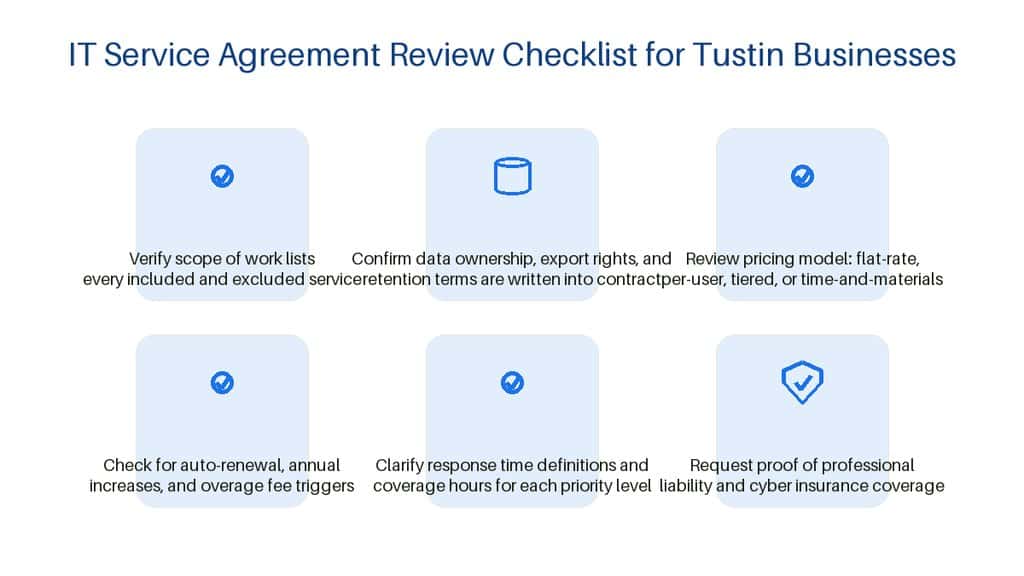
IT Service Agreement Review Checklist for Tustin Businesses
- ✓Verify scope of work lists every included and excluded service: Required
- ✓Confirm data ownership, export rights, and retention terms are written into contract: Required
- ✓Review pricing model: flat-rate, per-user, tiered, or time-and-materials: Required
- ✓Check for auto-renewal, annual increases, and overage fee triggers: Required
- ✓Clarify response time definitions and coverage hours for each priority level: Required
- ✓Request proof of professional liability and cyber insurance coverage: Required
- ✓Examine liability caps alongside exclusions, indemnities, and statutory rights: Required
- ✓Define termination notice period and transition assistance obligations: Required
- ✓Ensure exit provisions cover data migration, documentation handover, and overlap support: Required
Use this checklist during contract review and renewal negotiations.
Pricing Models and Billing Transparency
IT providers structure pricing as flat-rate monthly plans, per-user fees, tiered packages, or time-and-materials billing. Each model carries different risk: flat-rate gives budget predictability, while time-and-materials shifts cost uncertainty to the client.
Watch for auto-renewal clauses, annual price escalators, and overage fees. Some agreements bill separately for after-hours support or emergency on-site visits.
Ask for a written sample invoice before signing so you understand what triggers extra charges.

Response Times and Service Level Expectations
Service level agreements specify how quickly the provider responds to different priority levels. Urgent issues like server outages typically warrant faster response than routine password resets.
Verify whether response time means an engineer begins work or merely acknowledges the ticket. Also confirm coverage hours: 24/7 monitoring differs from 24/7 live support, and holiday coverage may carry premium rates.
Data Ownership, Access, and Exit Provisions
Data ownership, access, export format, retention, deletion, and migration obligations must be explicitly written into the agreement; it is not an automatic universal legal rule. Never assume your business automatically retains full rights to data stored on a provider’s systems.
The contract should state your right to extract data in standard formats upon termination, specify how long the provider retains backups after exit, and define secure deletion procedures. Without these terms, you risk losing access to critical records when switching providers.
Liability, Insurance, and Risk Allocation
Liability caps are one factor among enforceability under contract, applicable California law, negotiated exclusions, insurance, indemnities, and statutory rights. The cap alone does not determine who bears the full cost of a breach, outage, or data loss.
Request proof of professional liability and cyber insurance. Review whether the agreement excludes consequential damages, which can leave your business uncovered for lost revenue during extended downtime.
Consider whether the coverage matches your actual exposure.
Termination Rights and Transition Assistance
One to three months is described as a fair reference range for termination notice, rather than a fixed legal requirement. Your agreement should specify the exact notice period and whether it applies to both parties equally.
Ask about transition assistance: will the outgoing provider cooperate with your new IT team, hand over documentation, and maintain security patches during the overlap? Some contracts impose exit fees or data retrieval charges that appear only in the fine print.

How GTI 24/7 Structures IT Agreements for Orange County Businesses
GTI 24/7 was established in 2004 and offers a wide range of custom IT solutions for small and medium-sized businesses, healthcare, and enterprises. The company combines services to provide customized help and guidance so clients only receive what they need and want, rather than packaged solutions.
The company serves businesses across Orange County, including Tustin, CA, Santa Ana, CA, Irvine, CA, and surrounding communities, with proactive monitoring and remote support to handle tech issues quickly without requiring on-site visits.
Vendor Lock-In and Technology Independence
Many IT agreements quietly create dependency through proprietary tools or exclusive platforms. Tustin businesses should examine whether the provider requires specific software that cannot be easily transferred to another vendor.
Proprietary monitoring agents or remote management tools often remain installed after contract termination. These tools may become non-functional or require costly licensing to maintain independently.
Request clarity on which technologies are vendor-neutral versus vendor-specific. Open standards and widely adopted platforms reduce switching costs if you ever need to change providers.
Some agreements include clauses that restrict your ability to work with competing IT firms during or after the contract period. These non-compete provisions can limit your flexibility during transitions.
Data formats matter significantly when considering vendor independence. Ensure your agreement specifies that data exports use common, readable formats rather than proprietary structures.
Hardware ownership represents another lock-in risk. Determine whether leased equipment must be returned, purchased, or can transfer to a new provider without penalty.
GTI 24/7 designs its agreements around portable, standards-based solutions. This approach protects Tustin clients from artificial barriers when evolving their technology partnerships.
Regulatory Compliance and Industry-Specific Requirements
Tustin businesses in healthcare, finance, and legal sectors face strict regulatory frameworks that IT providers must support. Your agreement should explicitly address compliance obligations rather than assuming they are covered.
HIPAA, PCI-DSS, and California Consumer Privacy Act requirements each demand specific technical and procedural safeguards. Generic security promises in contracts rarely satisfy auditor scrutiny when incidents occur.
Request documentation of the provider’s compliance certifications and audit history. These materials demonstrate institutional commitment rather than mere marketing claims about security awareness.
Business associate agreements and similar addendums often accompany regulated industry contracts. Verify that these documents are incorporated by reference and not treated as separate, optional attachments.
Incident response procedures must align with regulatory notification timelines. California breach notification laws impose strict deadlines that your IT provider’s processes must accommodate without delay.
Training and awareness obligations sometimes fall ambiguously between client and provider. Clarify who bears responsibility for educating end users about compliance-relevant security practices.
GTI 24/7 maintains documented compliance protocols tailored to Orange County’s diverse industry base. This preparation helps Tustin clients demonstrate due diligence during regulatory examinations.
Performance Metrics and Continuous Improvement Commitments
Service level agreements often focus on reactive measures like uptime percentages and response times. Forward-looking contracts should also include metrics that drive ongoing service enhancement.
Quarterly business reviews represent one mechanism for structured performance evaluation. These sessions should examine trends, recurring issues, and opportunities for process refinement rather than simply reviewing ticket counts.
Request baseline measurements during contract inception to enable meaningful comparison over time. Without initial benchmarks, claims of improvement remain impossible to verify objectively.
Technology roadmap discussions belong in recurring performance conversations. Your provider should proactively identify emerging tools or practices that could benefit your specific operational context.
Customer satisfaction scoring provides qualitative balance to quantitative technical metrics. Consider whether your agreement includes periodic surveys with defined response targets and improvement obligations.
Penalty structures for missed SLAs sometimes dominate contract negotiations. Equally important are incentive mechanisms that reward exceptional performance or innovation delivery beyond baseline expectations.
GTI 24/7 embeds continuous improvement cycles into its client relationships across Tustin and Orange County. This commitment transforms agreements from static documents into evolving partnerships that adapt to business growth.

Frequently Asked Questions
What should Tustin businesses look for first in an IT service agreement?
Start with the scope of work and confirm every service you expect is listed explicitly. Then verify data ownership terms, liability provisions, and termination rights before discussing price.
Are flat-rate IT plans better than hourly billing?
Flat-rate plans convert unpredictable IT costs into a fixed monthly budget, which helps with financial planning. Hourly billing may suit businesses with very low support needs, but it rewards reactive rather than preventive support.
How can a business protect its data when ending an IT contract?
Negotiate exit provisions before signing, including your right to data exports in standard formats, retention periods, and secure deletion certificates. These rights must be contractually specified rather than assumed.
Why does liability language in IT contracts matter so much?
Liability caps, insurance requirements, exclusions, and applicable law all interact to determine recovery after a loss. A cap that looks reasonable may become meaningless if consequential damages are excluded or insurance is insufficient.
Should a Tustin business have its attorney review an IT agreement?
For any contract governing critical systems or sensitive data, legal review is prudent. An attorney can flag unfavorable terms, suggest protective amendments, and confirm the agreement aligns with California law and your business’s risk tolerance.
How can Tustin businesses ensure their IT agreement supports future growth?
Look for scalable pricing structures, flexible service tier adjustments, and technology roadmap discussions built into quarterly reviews. Agreements should accommodate adding users, locations, or services without requiring complete contract renegotiation.
GTI 24/7 structures terms of services with growth provisions that help Tustin businesses expand seamlessly as their technology needs evolve.
