

Email remains the primary attack vector for cybercriminals targeting small and mid-size businesses across Orange County, including offices in Santa Ana and nearby Tustin. A single successful phishing message can lead to credential theft, wire fraud, or ransomware deployment that halts operations for days.
Understanding how email and spam protection works, what options exist, and how to evaluate them puts Santa Ana business owners in control of their risk. This guide breaks down the key concepts, compares protection models, and provides a practical checklist for making the right choice.
Key Takeaways
- Email-borne attacks account for the majority of initial breaches in small and mid-size businesses, making inbox protection a foundational security control.
- Cloud-based email security filters threats before they reach user inboxes, while on-premises gateways require dedicated hardware and maintenance overhead.
- Multi-layered protection combining gateway filtering, user training, and post-delivery detection reduces risk more effectively than any single tool alone.
- Flat-rate monthly plans eliminate surprise costs and align provider incentives with your uptime, rather than rewarding reactive break-fix billing.
Why Email Security Is a Top Priority for Santa Ana Businesses
Santa Ana’s business landscape includes healthcare practices, professional services firms, manufacturers, and family-owned companies that rely on email for client communication, billing, and document exchange. Each of these industries faces regulatory and financial pressure to keep communications secure and available.
A compromised email account gives attackers access to sensitive client data, financial records, and the trust relationships that drive revenue. Recovery costs extend beyond technical remediation to include legal notification, credit monitoring, and reputational damage that can persist for years.
Email Security Evaluation Checklist for Santa Ana Businesses
- ✓Verify inbound filtering includes sender reputation, attachment scanning, and URL analysis: Required baseline capability
- ✓Confirm outbound filtering and domain reputation monitoring are included: Prevents blacklist damage from compromised accounts
- ✓Require time-of-click URL protection and attachment sandboxing: Catches delayed and evasive threats
- ✓Evaluate integration with existing identity and access management systems: Reduces administrative overhead and enables conditional policies
- ✓Assess quarantine management and end-user self-service release options: Minimizes help desk burden from false positives
- ✓Review compliance support for applicable regulations (CCPA, HIPAA, FINRA): Aligns technical controls with legal obligations
- ✓Confirm provider offers flat-rate monthly billing rather than per-incident charges: Enables predictable budgeting and aligned incentives
- ✓Validate 24×7 monitoring and rapid incident response capabilities: Reduces exposure window when threats bypass filters
Apply this checklist when evaluating any email security solution for your Orange County business.
How Email and Spam Protection Technology Works
Modern email security operates at multiple stages of message delivery. Gateway filters examine sender reputation, attachment signatures, and URL destinations before messages reach the mail server.
This catches bulk spam and known malware at the perimeter.
Post-delivery protection adds another layer by analyzing message content, user behavior, and communication patterns after delivery. Advanced systems use machine learning to detect business email compromise and impersonation attempts that bypass initial filters.
User-facing controls complete the stack. Warning banners on external messages, report-phishing buttons, and quarantine digests give employees context and agency without requiring them to become security experts.

Cloud-Hosted vs. On-Premises Email Security: A Comparison
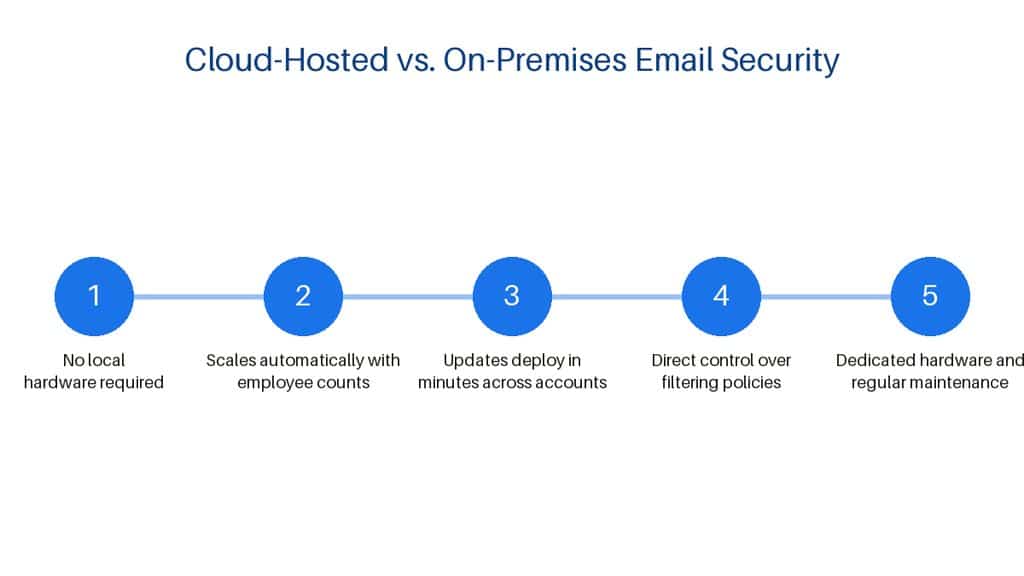
Cloud-hosted email security requires no local hardware and scales automatically as employee counts change. Updates deploy in minutes across all protected accounts, and providers absorb the infrastructure burden.
This model suits Santa Ana businesses with limited IT staff or multiple locations across Orange County.
On-premises gateways sit at the network edge and offer direct control over filtering policies and data flow. They demand dedicated hardware, regular maintenance, and skilled administration that many small businesses find unsustainable.
The total cost of ownership typically exceeds cloud alternatives when staffing and refresh cycles are included.
Hybrid approaches exist but add complexity. Most managed IT providers now recommend cloud-native protection for standard business use, with on-premises retention only where specific compliance requirements demand local data custody.
Key Features to Evaluate in Email Protection Solutions
Inbound filtering accuracy matters most. Look for solutions with low false-positive rates on legitimate business correspondence, since excessive quarantines drive employees to personal email accounts and shadow IT.
Outbound filtering prevents compromised accounts from becoming attack launchpads. This protects your domain reputation and keeps your business off email blacklists that disrupt client communication.
Attachment and URL protection should include sandboxing that detonates suspicious files in isolated environments. Time-of-click URL rewriting protects against links that redirect to malicious destinations after initial delivery.
Integration with identity systems simplifies administration and enables conditional access policies. A user flagged for risky sign-in behavior should see elevated email scrutiny without manual policy updates.
Regulatory and Compliance Considerations
California businesses handle personal information subject to the California Consumer Privacy Act and related regulations. Email systems containing client data require appropriate safeguards, access controls, and incident response procedures.
Healthcare providers in Santa Ana and Tustin must also consider HIPAA security rule requirements for electronic protected health information. Email containing PHI needs encryption in transit and at rest, with audit logging and access controls that demonstrate compliance during investigations.
Financial services firms face additional obligations under SEC and FINRA guidance for electronic communications retention and supervision. Your email protection solution should support archiving, legal hold, and supervisory review without creating separate data silos.

How GTI 24/7 Approaches Email and Spam Protection for Orange County Clients
GTI 24/7 delivers email and spam protection as part of integrated managed IT services for businesses across Orange County, including Santa Ana, Tustin, and surrounding communities. The company was established in 2004 and provides customized solutions rather than packaged products that include unnecessary features.
Each engagement begins with investigation of the client’s actual business needs, email volume, compliance requirements, and existing infrastructure. GTI 24/7 combines proactive monitoring with remote support capabilities that resolve issues quickly without requiring on-site visits for every alert.
Flat-rate monthly plans align costs with business planning and eliminate the surprise invoices common with break-fix arrangements.
GTI 24/7’s service area includes Anaheim, CA, Costa Mesa, CA, Garden Grove, CA, Irvine, CA, Fountain Valley, CA, Lake Forest, CA, Long Beach, CA, Newport Beach, CA, San Clemente, CA, Santa Ana, CA, and Tustin, CA, with remote support extending coverage efficiently across the region.
The Hidden Costs of Inadequate Email and Spam Protection in Tustin
Many Tustin businesses underestimate the true financial impact of weak email defenses. A single successful spam infiltration can trigger hours of staff downtime, IT remediation, and lost productivity that far exceeds any monthly protection subscription.
Employee distraction represents one of the largest hidden costs. Workers in Orange County offices spend valuable minutes daily sorting suspicious messages, deleting junk, and second-guessing inbox legitimacy instead of focusing on revenue-generating tasks.
Reputation damage compounds these losses quickly. When compromised Tustin business accounts send spam to clients and partners, rebuilding trust requires extensive outreach and sometimes contractual concessions.
Data recovery expenses surge when malicious attachments slip through basic filters. Restoring corrupted files, rebuilding mail servers, and conducting forensic analysis drains budgets that smaller Tustin companies cannot easily absorb.
Customer churn follows prolonged email disruptions. Orange County clients expect reliable communication; repeated bounce-backs or missed messages drive them toward competitors with more professional infrastructure.
Insurance implications are increasingly relevant for Tustin businesses. Cyber insurers now scrutinize email protection standards closely, and inadequate safeguards can trigger premium increases or coverage denials after incidents.
Proactive investment in robust email and spam protection eliminates these cascading costs. GTI 24/7 helps Tustin clients calculate true risk exposure and implement defenses that protect both immediate operations and long-term business viability.

Building a Culture of Email Vigilance Across Your Tustin Organization
Human behavior remains the critical variable, and cultivating awareness throughout your Orange County organization strengthens every technical safeguard you deploy.
Regular training sessions tailored to Tustin industry contexts produce measurable improvements. Staff who understand current phishing techniques, social engineering tactics, and verification protocols become active defenders rather than vulnerable entry points.
Simulated phishing exercises reinforce learning without exposing real data. GTI 24/7 designs realistic scenarios that help Tustin employees recognize subtle warning signs they might otherwise overlook during busy workdays.
Clear reporting procedures empower quick response when threats emerge. Tustin teams need simple, well-known channels to flag suspicious messages so IT specialists can analyze patterns and update protection rules promptly.
Leadership modeling sets the tone for organizational vigilance. When executives in Orange County businesses demonstrate careful email habits, employees at every level recognize that security represents a shared priority rather than an IT department burden.
Reward systems can sustain engagement over time. Recognizing Tustin staff members who identify sophisticated spam attempts or who complete advanced training modules keeps email security visible and valued.
GTI 24/7 partners with Tustin clients to develop comprehensive awareness programs that complement technical email and spam protection. This integrated approach creates resilient organizations where people and technology work together against evolving threats.
Frequently Asked Questions
What is the difference between spam filtering and full email security?
Spam filtering blocks unsolicited bulk email and known malicious senders. Full email security adds protection against targeted phishing, business email compromise, account takeover, and advanced malware that evades basic filters.
Most Santa Ana businesses need the broader capability as primary protection.
How much should a small business budget for email protection?
Cloud-based email security typically runs on a per-user monthly model. Exact pricing depends on feature depth, compliance requirements, and whether the solution is standalone or bundled with broader managed IT services.
GTI 24/7 offers flat-rate monthly plans without published dollar amounts, customized to each client’s scope.
Can email protection stop all phishing attacks?
No solution stops every attack, which is why layered defense matters. Technical filters catch most automated threats.
User training and simulated phishing exercises reduce success rates for messages that reach inboxes. Post-delivery detection and rapid incident response limit damage from anything that slips through.
How quickly can email protection be deployed for a Santa Ana business?
Cloud-native solutions typically activate within hours for standard configurations. Complex integrations with legacy systems or specialized compliance requirements may extend timeline.
GTI 24/7’s remote support capabilities accelerate deployment without waiting for on-site scheduling.
What happens if legitimate email gets blocked?
Modern systems provide quarantine digests and self-service release options that reduce administrator burden. False-positive tuning during the first weeks of operation improves accuracy.
GTI 24/7’s proactive monitoring identifies patterns that suggest filtering misconfiguration before users complain.
Does email protection help with compliance requirements?
Properly configured email security supports compliance with encryption, access logging, and data loss prevention controls. GTI 24/7 investigates each client’s specific regulatory environment to align technical controls with actual obligations.
